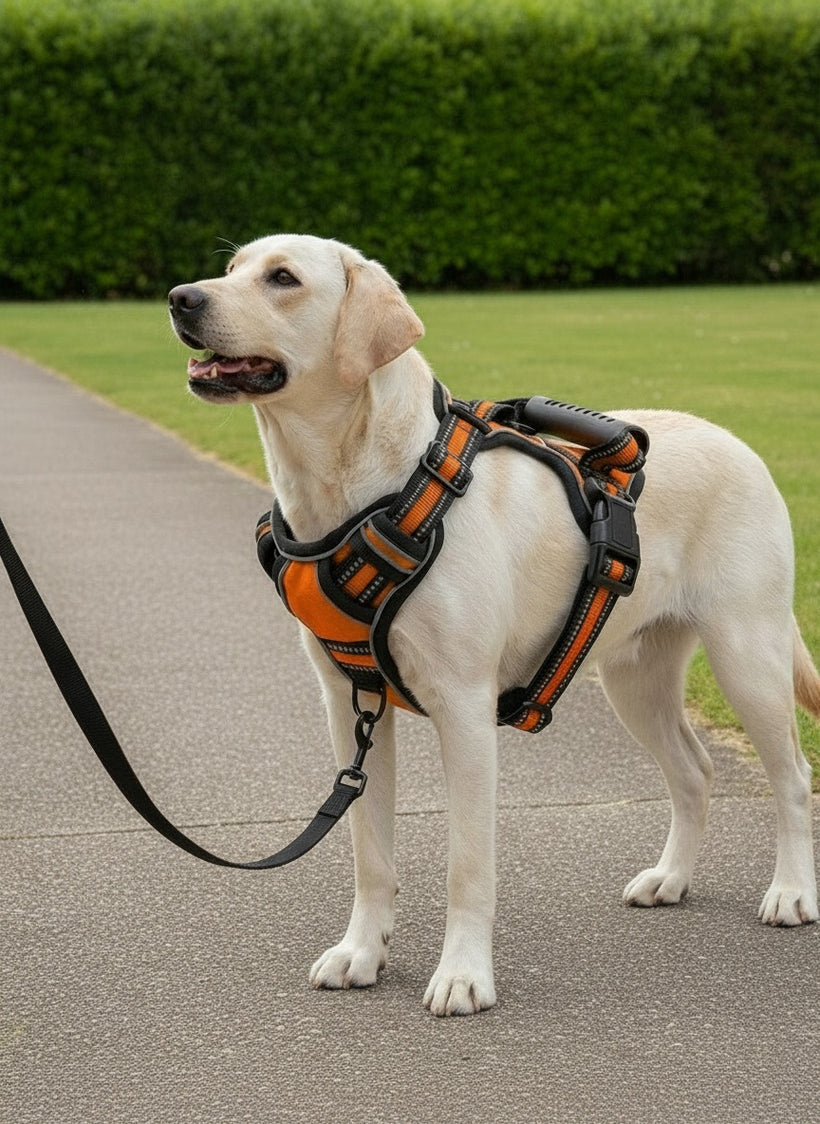
85 lb shepherd mix, two years of him walking me instead of the other way around. Classes, treats in the pocket, stopping every time he pulled. He is just strong. The clip sits on his chest with this one, and the first time he hit the end of the leash it turned him sideways toward me instead of launching him forward. He had quit testing it by the end of that walk.
1 / 8
Built to stop the pulling
No-Pull Dog Harness
- The ring is at the front, on the chest: when they pull, their body turns back towards you instead of driving forward
- Nothing tightens on the neck: no more choking, no more coughing
- Handle on the back to hold them short, reflective strips for evening walks
- On in seconds, fully adjustable
It is not your dog
Look at where the lead clips on.
On almost every harness, the ring sits on the back. When your dog pulls, they have something to push against, and the harder you hold, the harder they push. It is the sled dog principle: you do not train a dog to pull, you equip them for it.
A back ring gives them leverage: every time you hold the lead, they push against it.
With the ring on the back, all their weight goes forward, and you go with it.
A collar holds by the neck. A dog that pulls is not put off by coughing, they keep going.
The problem was never your dog. It is where the lead clips on.
Back clipThe lead holds them from behind. They push, you hold, they move forward anyway.
Chest clipWhen they pull, their front turns back towards you. Pulling stops working, so they stop.
The idea is not new: trainers call it a front-clip harness. What changes is that you have nothing to teach your dog. The first time they pull, their body turns. The second time, they pull less. No jerk, nothing that hurts them.
Size guide
The right size is half the result.
A harness that is too big slides and twists when they pull. Too small and it rubs under the legs. Take two minutes and a soft tape measure.
| Size | Chest | Neck |
|---|---|---|
| XS | 12.5 - 15.5 in (32 - 40 cm) | 11 - 14 in (28 - 36 cm) |
| S | 14 - 19.5 in (36 - 50 cm) | 14 - 18 in (36 - 46 cm) |
| M | 18 - 25 in (46 - 63 cm) | 17.5 - 21.5 in (44 - 54 cm) |
| L | 21.5 - 28 in (54 - 71 cm) | 18 - 25 in (46 - 64 cm) |
| XL | 27 - 36.5 in (68 - 93 cm) | 23.5 - 31 in (60 - 79 cm) |
The chest measurement decides the size; the neck is there to confirm it. Between two sizes? Take the larger one. If the size is wrong, we exchange it.
What changes on every walk
Every known flaw has been designed out.
Our commitment
Try it for 60 days, on real walks.
Try it for 60 days of real walks. If nothing changes, you get your money back.
The warranty against manufacturing defects is for life.
- 60 daysor your money back
- Exchangeif the size is wrong
- Size exchangelabel provided
Common questions
What you are wondering before you order.
What do I get with my order?
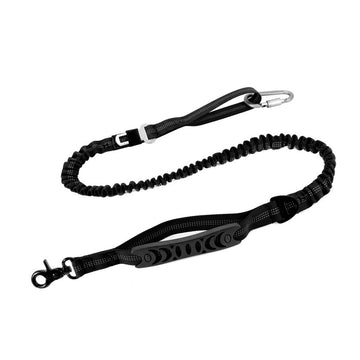
The harness on its own: the Belamya harness, in the colour and size you choose. The Signature Pack: the harness, the 5 ft shock-absorbing lead, the matching collar, the bag dispenser and two patches embroidered with the name you enter at checkout. Embroidery adds a few days before shipping.
How do I know it will work for my dog?
It does not depend on their character but on where the lead clips. At the front, on the chest, pulling turns them back towards you instead of driving them forward. A strong dog, a puppy, a dog that lunges at everything: it works the same way.
How long before I see a difference?
On the first walks. There is nothing to teach: the first time they pull, their body turns; the second time, they pull less. Every dog takes its own time, but you feel the difference on the first walk.
Is it suitable for puppies?
Yes. Go by the chest they have today, the harness adjusts, and you move up a size when they have grown.
Can it rub or restrict their movement?
The straps are padded and sit above the armpits when the harness fits; the cut leaves the shoulders free. Too small and it rubs, too big and it twists, which is why the size guide matters.
I have already tried a no-pull harness and nothing changed.
Look at where the lead clipped on: the back, almost every time. A back-clip harness is called no-pull on the label, not on the sidewalk. Here the ring is on the chest, and that is the only detail that counts.
Is it hard to put on?
No. Over the head, one buckle, and you are out the door. If you can fasten a seatbelt, you can fit a Belamya.
How do I pick the right size?
With a tape measure and the chart above: chest measured just behind the front legs. The chest measurement decides, weight is only a guide. Between two sizes, email us the breed and weight and we answer before you order.
What if the size is wrong?
Email us your order number and the chest measurement you took: we send the right size at no charge, and you keep the first one — no need to send it back.
Shipping and warranty?
Free shipping, tracked: your order is shipped within 1 to 7 business days, then 4 to 7 business days in transit for most orders (a few extra days for the pack embroidery). You get the tracking number the day it leaves. 60 days of walks. If they still pull as hard, you tell us and we refund you.
Against an ordinary harness
What we kept, what we changed.
| Ordinary harness | Collar | ||
|---|---|---|---|
| Ring at the front, on the chest | ✓ | On the back | ✗ |
| Nothing on the neck | ✓ | ✓ | ✗ |
| Handle to hold them short | ✓ | Sometimes | ✗ |
| Straps padded | ✓ | Sometimes | ✗ |
| Reflective bands | ✓ | Sometimes | Rarely |
| Size exchange | ✓ | Depends on the seller | Depends on the seller |
| 60 days of walks | ✓ | Rarely | Rarely |
What owners say
12 walks, told by the people who took them.
Very determined beagle. He still wants to go say hi to everything, he just can't drag me there anymore.
The front clip does what it says, my lab mix doesn't pull now. But the side straps worked themselves loose after a few walks and I had to stop and pull them tight again. Once I started checking them before we went out it stopped being a problem. Nobody told me to.
My arm and my shoulder are very grateful.
I'm 5 foot 3 and he's a 70 lb pit mix, so you can picture how the old walks went. I had started dreading them. He still pulls at the start when he's excited but it doesn't move me the way it used to, and he settles within a block.
No complaints on the main job, our golden quit pulling after about three tries. Taking off one star because the handle sits under a lot of fur on him and I end up digging for it.
Got one for the older dog, ordered the same for the younger one two weeks later.
Six weeks of private sessions for our cattle dog. She learned everything, textbook loose leash in the trainer's yard, then home on her old harness and she hauled me around the block like none of it had happened. My wife ordered this one and I thought it was money wasted. It isn't. I still don't fully get why. I think the front strap just gets in her way enough that she gives up. Docking a star because she ducks away every time it goes over her head.
Four adjustment points and he can't back out of it, which was the whole problem with the last two we tried. The leash is slack most of the time now.
Works well once it fits. I ordered by weight the way I always have and it was too big through the chest. Measured her properly, went a size down, and it's right now.
He doesn't pull at all now. Different dog.
Not the right shape for a dachshund. The material and the stitching are fine and I can see why it works for most dogs, but on a long low body the chest piece rode up toward his throat no matter which adjustment I used. Tried a size down and a size up. Neither was right for him.
The next walk
You do not have a difficult dog. You have a harness that holds them from behind.
Change where the lead clips on, and watch what happens on the very first walk.